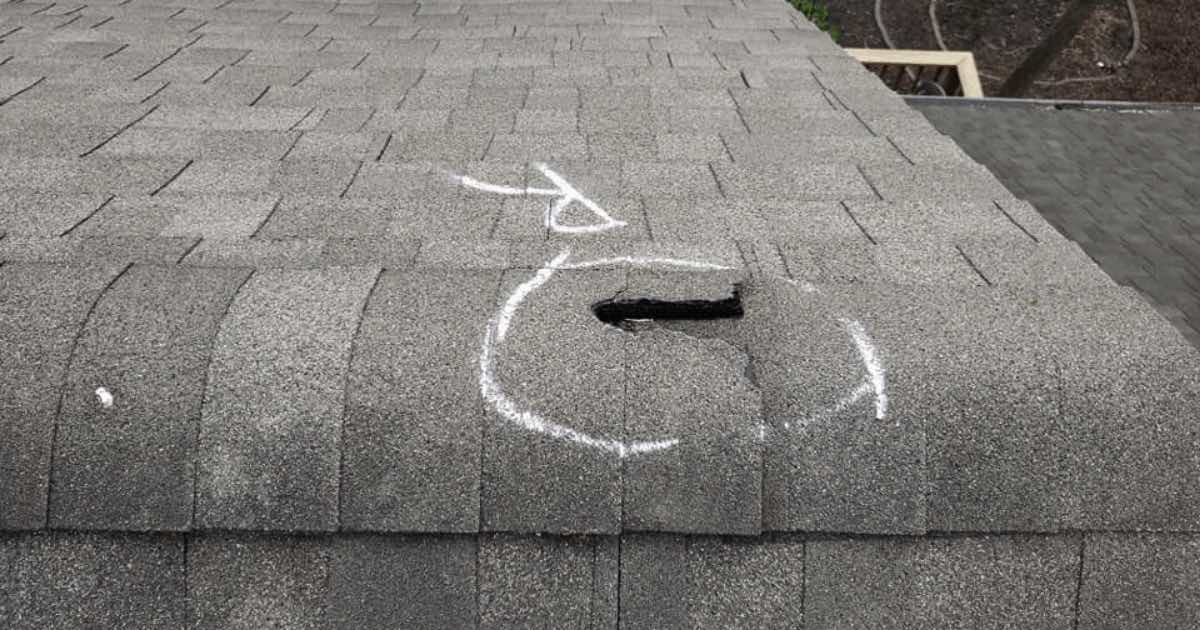
How do you identify hail damage on your roof?
There are a lot of factors that play into roof damage from a hail storm. The intensity of the wind, the size, and density of the hail, the material your roof is made from, and any barriers (like trees) that might be in the way are all variables that should be considered.
Sometimes, hail damage can be easily recognizable, like when shingles are split or dented. However, there are times when even though the roof was weakened, there is no visible damage from the outside. This is especially concerning, given that it can lead to water damage and leaking.
Keep in mind that every storm is different, so it is important to have your roof inspected even if everything seems fine.
My roof has been hit by a hail storm - What now?
If hail damage is visible on your roof, the first thing you need to do is document it. Make sure you take pictures and write down details, like the date, so you remember what to tell your insurance company.
But even if there’s no evident loss, it’s important to have your roof inspected. That’s because damage can present itself in many different ways and it can be difficult for an untrained eye to spot it.
Moreover, hail can cause silent damage, meaning it can be the source of a future leak down the road. If you fail to determine this damage right away, it might be too late to file your claim or prove it can be traced back to a hail storm.
How long do I actually have to file my claim?
There is not one unique answer that applies to all cases here. Some insurance companies have their time limits set for only 30 days, while a few others have it for as long as 2 years after the damage.
However, most insurance companies will allow you to file a hail claim within a year from the date of loss. Still, it is completely up to the insurance company to determine this time limit. For this reason, you should check your policy or contact your insurer as soon as possible after a hail storm.
If you miss the deadline, not only can the insurance company deny your claim, but you are also more at risk of having extra damage from the original damage not being fixed timely. In this case, you will be fully responsible for covering all of the costs.
Also, remember: this timeline starts from the date of loss, not from the date you discovered the damage! So be sure to always check your roof after a storm.
The takeaway:
- Hail damage doesn't always look the same and sometimes it’s “hidden”
- Have your roof inspected as soon as possible after a hail storm
- Document everything
- Call your insurance company, discover their time limit, and get to filing your claim!
Now you are prepared to talk to your insurance company after your roof has suffered hail damage. What's next? Read about how a hail damage claim works to understand the ins and outs that go into your claim.